Osaka Travel Guide: Everything You Need to Know Before You Go
Affiliate note: This article may contain affiliate links, which means I may earn a small commission if you book or buy through them – at no extra cost to you. I only recommend things that make sense for this kind of trip.
There’s a moment that happens in Osaka. You’re standing at Ebisubashi Bridge at night, the Glico running man is blazing in neon above the canal, the smell of takoyaki is drifting from somewhere to your left, and someone nearby is already on their third skewer of kushikatsu. And you think: why did I spend so long planning Kyoto when this city exists?
Osaka doesn’t ask you to slow down and appreciate it. It just grabs you by the collar and drags you into the nearest izakaya. It’s loud, chaotic, ridiculously good at feeding you, and one of the most fun cities in Japan!
This Osaka travel guide covers everything you actually need: what to do, where to stay, how to get around, and where to eat. Every trip I find something I missed before. Here’s what I’d tell you over a beer.
What Makes Osaka Worth Your Time?
Japan just wrapped Expo 2025, which brought over 28 million visitors to the city and put Osaka on the global radar harder than ever. The infrastructure has improved, the international food scene has expanded, and more travellers are using it as a base for the whole Kansai region — day trips to Kyoto, Nara, and Kobe are all under an hour from here.
But Osaka’s appeal isn’t new. It runs on a philosophy called kuidaore — roughly translated as “eat until you drop.” The city has built an entire identity around affordable, soul-satisfying food, and it delivers on that promise every single time.
Compared to Tokyo, it’s easier to navigate, noticeably cheaper, and far more willing to have a good time. That’s not a slight against Tokyo. It’s just a different kind of city.
How Do You Get Around Osaka Without Getting Lost?
The honest answer: Osaka’s metro is one of the easiest subway systems in Japan to use, and that’s saying something.
The Osaka Metro
The Midosuji Line is your spine. It connects Shin-Osaka (bullet trains) in the north straight down through Umeda, Shinsaibashi, Namba, and Tennoji. Almost everything you want is on or within one stop of this line. Get an ICOCA card (¥1,000 including a ¥500 deposit) at any JR station or Kansai Airport — it works on every train, bus, and subway in the city, and at most convenience stores too.
The Osaka Amazing Pass
If you’re planning to visit multiple paid attractions, the Osaka Amazing Pass is worth doing the math on. The one-day pass (¥3,500) includes unlimited metro and bus travel plus free entry to over 40 attractions, including the Umeda Sky Building and the Osaka Aquarium. Two days runs ¥5,000. It pays for itself surprisingly fast.
Getting Around on Foot
Dotonbori, Namba, and Shinsaibashi are all walkable from each other — and honestly, the best way to experience them. Google Maps with offline maps downloaded is all you need. Taxi apps like GO work well late at night when the last metro has gone.
The Best Things to Do in Osaka
You won’t run out. But here’s where to put your time first.
Dotonbori
This is Osaka’s most iconic neighbourhood and the first place you should go when you arrive. The neon-lit canal, the Glico sign, the dense cluster of restaurants, street food stalls, and arcade shops — it’s everything at once and somehow it works. Come in the evening for the full effect. Early morning is eerie in the best way — the neon still glows but the crowds are gone.
Hozenji Yokocho, the mossy stone alley just off the main drag, is worth ducking into. It’s quiet, atmospheric, and home to some of the best traditional restaurants in the area. The contrast with the chaos outside is immediate.
Osaka Castle
The castle itself is a 1930s reconstruction inside, so manage expectations on the interior — it’s a museum now rather than a preserved original. But the surrounding park and moat are legitimately beautiful, especially in spring. The Japan travel guide covers the broader context if you want to understand where it sits in Japanese history.
Arrive early. The park opens before the castle does, and the morning light on the stone walls with no one around is a genuinely good hour.
Umeda Sky Building
Two towers connected by a floating sky garden on the 39th floor. The views are 360 degrees over the city, and the structure itself is worth seeing architecturally. It’s included in the Osaka Amazing Pass, which makes the ¥1,500 entry price a non-issue if you’ve already bought one. Go at sunset. Trust me on this one.
Osaka Aquarium Kaiyukan
One of the largest aquariums in the world, built around a central Pacific Ocean tank that you descend through on a slow spiral walkway. It takes about two hours to do properly. If you’re travelling with kids, it’s a full morning. Entry is around ¥2,300.
What Should You Eat in Osaka?
Everything. But let’s be specific.
The Street Food Circuit
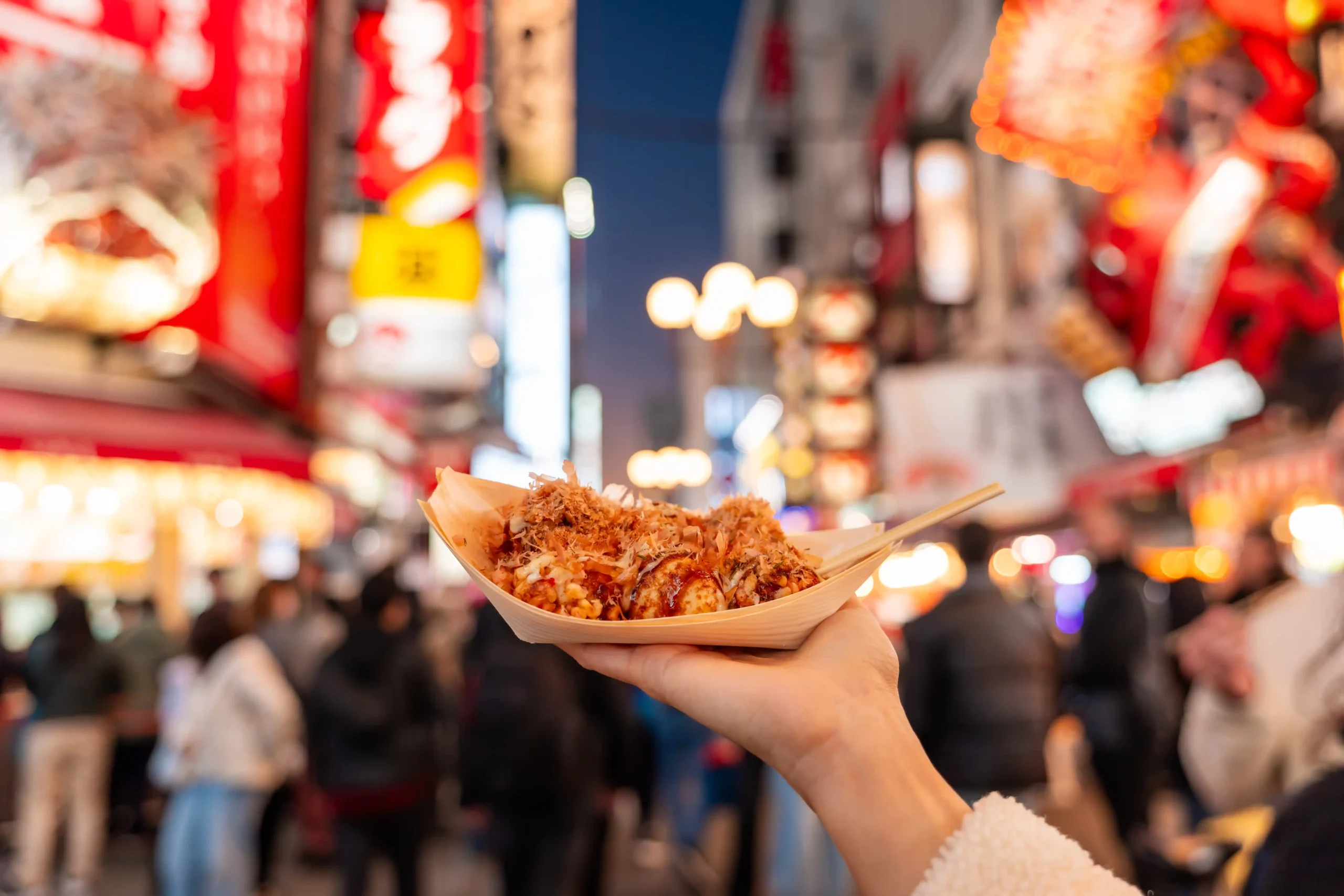
Osaka’s street food is a trip in itself. The classics: takoyaki (octopus balls — crispy outside, molten inside, topped with bonito flakes and sauce), okonomiyaki (a savoury pancake that you partly cook yourself at the table), and kushikatsu (battered and deep-fried skewers, served with a communal dipping sauce — the first rule of kushikatsu is never double-dip).
For takoyaki, Takoya Dotonbori Kukuru near Ebisubashi Bridge does the version everyone photographs — the Bikkuri Takoyaki has an octopus tentacle sticking out of the dough and costs ¥780 for eight. It’s not a gimmick; it’s actually one of the better ones in the area.
Kuromon Ichiba Market, just east of Namba, is worth a morning visit before the crowds hit. Fresh sashimi on sticks, grilled scallops, rolled omelette — it’s 580 metres of food. Go before 11am.
Shinsekai for Kushikatsu
The Shinsekai neighbourhood is grittier than Dotonbori, less polished, and significantly more interesting for food. This is where locals actually eat kushikatsu, and the vibe is Showa-era retro in the best possible way. It’s a 10-minute metro ride from Namba. Worth the detour.
A Yakiniku Recommendation Worth Making
If you want a proper sit-down dinner with a strong local following, Sexmachine in Dotonbori is a yakiniku (Japanese BBQ) restaurant pulling a 4.7/5 on Google — which, for a grill restaurant where the standard is already high, means it’s doing something right. Find it on Google Maps, get there early or expect to wait, and order the cuts they recommend rather than defaulting to the safe choices. It’s the kind of place you’d walk past a dozen times without going in, then spend the rest of the trip telling people about.
A Hot Spring That’s Worth the Effort (Seriously)
This one’s a bit different. Kamigata Hot Spring Ikkyu — listed on Google Maps as a Super Public Bath — is a natural mineral spring bathhouse with its own restaurant inside. It only sits at 3.9/5 on Google, which I’ll admit made me hesitate. I went anyway. I’m glad I did.
The atmosphere is calm in a way that’s hard to find in the middle of a city break. Natural hot spring water, a proper food menu, and none of the tourist-circuit energy you get everywhere else. It’s the kind of place locals use to decompress, not a destination designed for visitors — which is exactly why it works.
Fair warning: getting there takes a bit of effort. It’s not on the main tourist loop, so budget some extra commute time and look it up on Google Maps before you set off. If you’re someone who needs a mid-trip reset between the neon and the eating, this is where you go.
Where Should You Stay in Osaka?
Short answer: Namba for first-timers, Umeda if you’re planning day trips.
Namba (Minami)
This is the best base if it’s your first visit to Osaka. You’re walking distance from Dotonbori, Kuromon Market, and the Shinsaibashi shopping arcade. The Midosuji Line runs straight through, connecting you to the rest of the city in minutes. The downside: Namba stays loud until 2 or 3am. If you’re a light sleeper, pay for a room with good soundproofing.
Umeda (Kita)
Umeda is the transport hub of Osaka. Direct trains to Kyoto, Nara, and Kobe leave from here, which makes it the smarter base if you’re using Osaka as a launchpad for the wider Kansai region. It’s cleaner, quieter, and has better shopping. The hidden neighbourhood of Nakazakicho, just a short walk north, is full of independent cafés and vintage shops — the kind of area that doesn’t show up in most guides.
Honmachi (Split the Difference)
If you can’t decide between the two, Honmachi sits right in the middle — literally. It’s cheaper than both, quieter than Namba, and within walking distance of most things. Less atmosphere, more practicality.
For accommodation tips across Japan, the accommodation guide has a full breakdown of what to expect at each budget level.
When Is the Best Time to Visit Osaka?
Spring (March to May) and autumn (October to November) are the strongest options for weather and atmosphere. Cherry blossoms hit Osaka Castle Park in late March to early April — it’s crowded, but it’s one of those things that earns the crowd. Autumn brings clear skies, comfortable temperatures, and noticeably fewer tourists than spring.
Summer is hot, humid, and busy. Not impossible, but you’ll sweat through your shirt on the way to the aquarium. Winter is quieter, cheaper, and perfectly manageable — Japan doesn’t really shut down in the cold.
Osaka attracted enormous crowds following Expo 2025 and that momentum has continued into 2026. Book accommodation at least 4–6 weeks in advance, especially during peak season. Hotel prices have risen meaningfully in the last year.
Practical Tips Before You Go
A few things worth knowing that the bigger guides skip over:
Cash still matters. Most street food stalls are cash-only in 2026. Bring enough yen for your first evening — ¥10,000 is plenty for two people to eat their way through Dotonbori.
Get an IC card at the airport. The ICOCA card is available at Kansai International Airport before you even hit the city. Do it there rather than at the station while you’re tired and jet-lagged.
The JR Pass doesn’t cover Osaka Metro. It covers the JR Loop Line, which is useful for the castle and a few other spots, but the metro runs separately. Budget for metro fares unless you’re getting the Osaka Amazing Pass.
One neighbourhood per morning. Osaka is compact but dense. Trying to do too much in one day leads to a lot of walking between things and not enough time at any of them. Pick one area, wander it properly, and eat as you go. That’s the Osaka approach.
Check the travel tips section for Japan-specific advice on SIM cards, JR Pass logistics, and what to pack.
Final Thoughts on Osaka
Osaka doesn’t need you to have read a guide to enjoy it. It’s one of those cities that works on instinct — you follow the neon, you follow the smell, and you end up somewhere good.
But going in with a rough plan means you don’t waste a morning figuring out that Umeda and Namba are 10 minutes apart on the metro, or that Shinsekai is worth the trip. Spend less time in transit, more time eating. That’s the whole strategy.
Have you been to Osaka? If there’s a restaurant, neighbourhood, or moment I’ve missed, drop it in the comments — I’m always looking for an excuse to go back.
Planning the wider Japan trip? The Japan Travel Guide covers everything from Tokyo to Hiroshima, with itineraries for every trip length.