Acadia National Park in Winter: What You Can Actually Do
Affiliate note: This article may contain affiliate links, which means I may earn a small commission if you book or buy through them – at no extra cost to you. I only recommend things that make sense for this kind of trip.
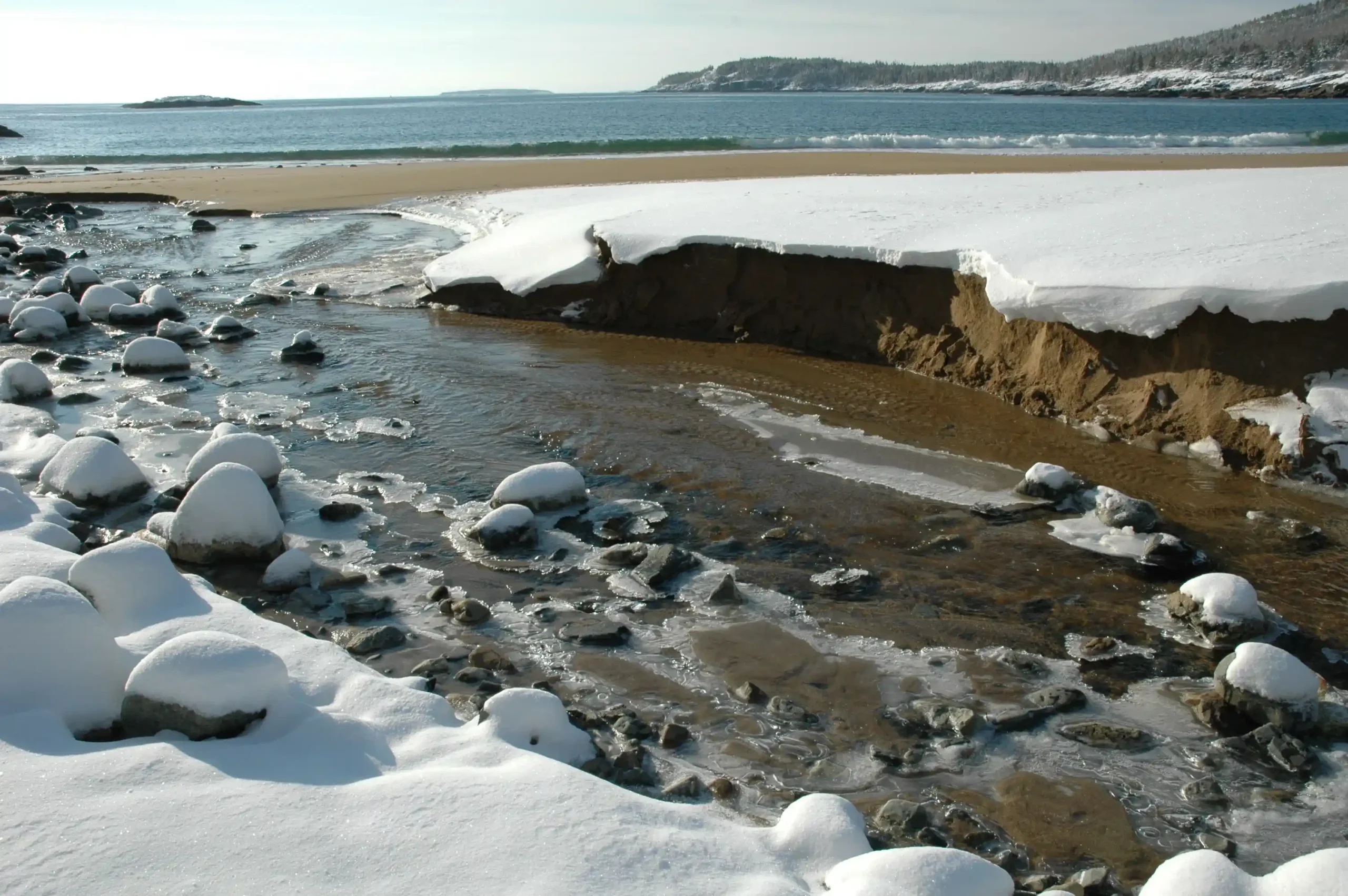
Snow meets the shoreline at Sand Beach, on the coastal stretch reached by the winter section of Ocean Drive.
NPS Photo
Acadia National Park in winter is still open for recreation. You just get a smaller, quieter version of the park, and it works on different rules from the one on the postcards.
Here’s what’s realistically on the table once the season turns:
- Drive a maintained stretch of Ocean Drive along the coast, when conditions allow.
- Reach the Jordan Pond parking area by its winter approach from Seal Harbor.
- Walk, snowshoe or ski a section of carriage road, depending on what the snow is doing that week.
That’s a shorter menu than summer, and it can still make a really good park day. You just can’t read the map like it’s July, with every pin a drive-up stop on one big loop. Each winter outing needs a verified way in, a turnaround point and a plan for getting out before dark.
Which Roads Are Open in Acadia National Park in Winter?
Most of the Park Loop Road closes to ordinary vehicles for the cold season. The National Park Service’s winter visitor guide for Acadia gives the usual pattern as December 1 to April 14, weather permitting. Treat that as a seasonal pattern, not a fixed appointment.
| Area | Normal winter access pattern | What it means for you |
|---|---|---|
| Most of Park Loop Road | Seasonally closed to ordinary vehicles | No summer-style loop drive. Plan separate outings instead. |
| Cadillac Summit Road | Closed to cars with the Loop Road | No winter summit drive. The road is a designated snowmobile route. |
| Ocean Drive (maintained section) | One-way vehicle access, entering via Schooner Head Road and exiting at Otter Cliff Road, subject to conditions | A short coastal drive, not the full Loop Road experience |
| Jordan Pond approach | Jordan Pond Road from Seal Harbor to the Jordan Pond parking area | Drive in, then return the same way to Seal Harbor |
| Carriage roads | Recreational routes, never public car routes | Reach them on foot, snowshoes or skis from an accessible start point |
| Schoodic Loop and Point roads | Listed as open year-round in NPS operating information | Separate part of the park on the mainland. Check current alerts. |
Ocean Drive and the Jordan Pond approach are two separate trips. You can’t link them on the closed remainder of the Loop Road, so moving between them means going back out onto the island’s public roads, which are state and county roads rather than park roads. NPS says park roads are plowed and sanded only during daylight and tells visitors to expect heavy snow and ice.
The Acadia maps page includes a winter roads and trails map. Check it alongside the current conditions and alerts page on the morning you go.
Most of the options above are on Mount Desert Island, where most first visits happen. Acadia also includes the Schoodic Peninsula, across Frenchman Bay on the mainland, where NPS lists the loop and point roads as open year-round. It’s a separate drive with its own conditions, not a quick add-on to an island day.
The Ocean Drive Section: A Short Coastal Drive
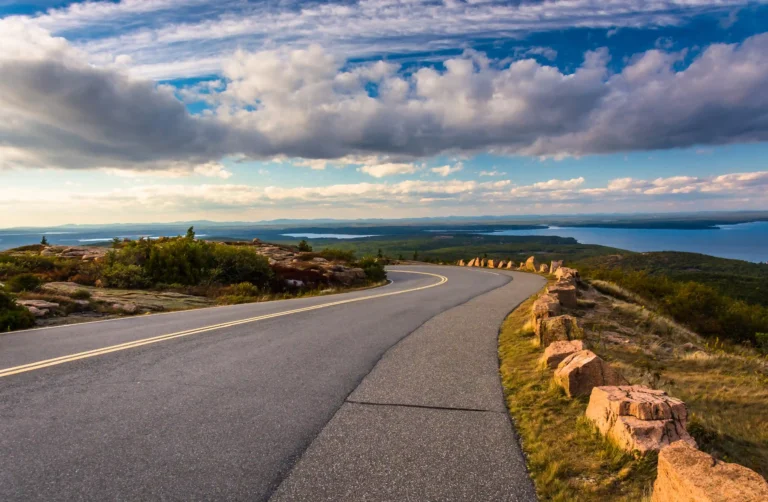
This is the closest thing to a classic Acadia drive in winter. NPS directs you onto Schooner Head Road south of downtown Bar Harbor, then into the park at the year-round entrance station. From there, the maintained section runs one way along the shore and exits at Otter Cliff Road.
It puts you on the coast around Sand Beach, Thunder Hole and Otter Cliff. Granite, open ocean, hardly any traffic.
Seeing the coast and getting out onto it are two different things, though. Road access doesn’t mean every path, staircase or rock ledge near those features is safe to walk. Steps get icy, granite turns slick, and the January 2024 storms damaged sections of Ocean Path and the Sand Beach stairs before temporary repairs. Look from places you can reach on solid footing, and keep well back from wet or icy rock.
Big surf is not a show to chase from the edge. Park only in designated spots, never in a travel lane or on an uncleared shoulder.
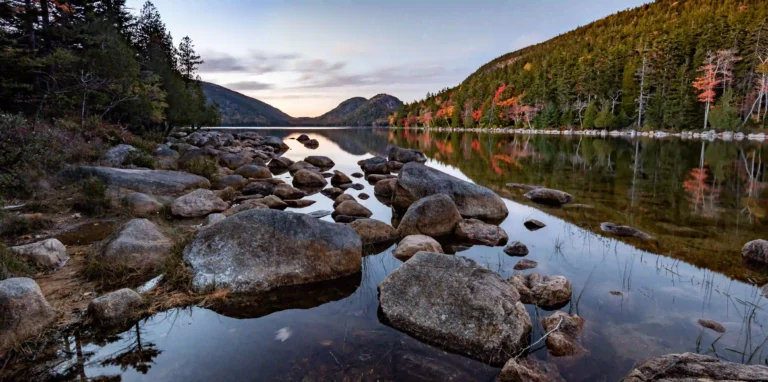
Jordan Pond in Winter: Without the Summer Assumptions
NPS describes the winter approach as Jordan Pond Road, which leaves Route 3 in Seal Harbor and leads to a short plowed section ending at the Jordan Pond parking area. When you’re done, you backtrack the way you came.
Getting the car into that lot doesn’t mean:
- Jordan Pond House is open. The restaurant and store are seasonal concessions, so don’t count on lunch or a hot drink.
- The full pond circuit is an easy winter stroll. Shore paths and boardwalk sections behave very differently under snow and ice.
- The ice is safe. Stay off the frozen pond. NPS notes that park ice rarely freezes evenly, and open water can appear on larger bodies of water.
A short out-and-back that suits the conditions can be the whole outing.
Which Winter Walks Make Sense in Acadia?
NPS points winter hikers toward Ocean Path, Ship Harbor and the carriage roads rather than harder summer routes. Treat that as a shortlist to choose from, not an “easy year-round” label.
Ocean Path
- What it offers: A shoreline walk along the same stretch of coast as the maintained Ocean Drive section.
- How to get there: Use the Ocean Drive approach and park only in a legal, cleared space.
- What to watch: Exposed granite, ice and spray-slicked rock. Parts of the path were damaged in the January 2024 storms, so check current conditions before you set out.
- Turning back: A short walk to one viewpoint and back is a perfectly good outing.
Ship Harbor
- What it offers: A smaller coastal walk on a different part of Mount Desert Island, a separate trip from the Ocean Drive stops.
- How to get there: Via the island’s public roads. Check parking for the day rather than assuming the lot is cleared.
- What to watch: Roots, rock and ice where the trail meets the shore.
- Turning back: If the trail is glazed, cut it short.
The carriage roads
- What they offer: Broad, gentler routes through woods and around lakes, the most forgiving surface in the park when not iced over.
- How to get there: Use the winter map to choose a start point you can actually drive to, then confirm parking on the day.
- What to watch: Packed snow, refrozen slush and groomed ski tracks (more on those below).
- Turning back: These go on for miles. Set a turnaround time before you start.
What Should You Carry for a Winter Walk in Acadia?
Traction matters, but it’s not a free pass. NPS says microspikes, cleats or ice grippers can help on snow and ice, yet they can be hazardous on bare, slick granite, and Acadia has plenty of that. Trekking poles help too. None of this gear makes a route appropriate that otherwise isn’t.
Check the forecast for wind and wind chill, not just temperature and snow. A calm morning in Bar Harbor can feel very different on an exposed stretch of coast or a wooded trail, so dress for where you’re actually walking. Layers do the work: a base layer that keeps moisture off your skin (cotton loses its warmth once it’s wet), an insulating layer, and an outer shell that stands up to wind and wet. Add a hat, gloves and insulated, waterproof boots. Spare socks and gloves earn their space on a longer outing or a slushy day, and hand warmers are a nice extra rather than a requirement.
Carry a detailed paper map, or dependable offline navigation with a backup, plus a separate headlamp or flashlight. NPS asks visitors not to rely on a phone as a map or flashlight, and cold can drain a phone battery faster than you’d expect, so keep it in an inside pocket. Bring food, water and enough warm clothing to cope with a delay. Winter days end early here, and if the footing, wind or light turns worse than you prepared for, turning around is the right call.
Skip the Beehive, the Precipice and the exposed summit climbs. A closed Cadillac road is not an invitation to hike Cadillac instead.
Snowshoeing and Cross-Country Skiing on the Carriage Roads
When the snow cooperates, this is the best of winter in Acadia. NPS says about 45 miles of carriage roads are open for walking, running, biking, snowshoeing and skiing in winter.
That doesn’t mean all 45 miles are groomed on the date you arrive. Volunteers from the Acadia Winter Trails Association groom ski tracks when there’s sufficient snow depth (NPS gives more than six inches) and the roadbed is frozen. Some winters deliver plenty of skiable days, others very few.
Friends of Acadia posts updates on its Ski Acadia carriage road grooming page, along with a grooming map. It’s the best guide to current conditions, so check the date on the latest update.
A few habits keep everyone happy:
- Don’t walk or snowshoe in the groomed ski tracks. Stay to the side, away from the classic tracks.
- Keep dogs on a leash of six feet or less. That’s federal law, and it rules out skijoring.
- Expect to share some routes. Snowmobiles aren’t allowed on most carriage roads, but the closed Park Loop Road system, including the road up Cadillac, is a designated snowmobile route. A road closed to cars isn’t necessarily a quiet walking path.
Bring your own skis or snowshoes, or sort out gear before you arrive rather than assuming you’ll find it on the island.
What Services Are Open in Acadia National Park in Winter?
Do You Need a Park Pass in Winter?
Yes. Acadia requires an entrance pass year-round, according to the NPS entrance pass page. The right pass depends on how you arrive.
For US residents, a private vehicle pass covers the car and everyone in it, and a motorcycle pass covers the bikes and riders. An individual pass is for someone arriving on foot or by bike, needed only from age 16. An America the Beautiful pass also covers entry.
Visiting from Canada or anywhere else outside the US? NPS now charges non-US residents aged 16 and older a separate per-person nonresident fee on top of the standard pass, and it applies to each qualifying person in the car, not just the driver. A valid annual pass can cover this additional fee for the people admitted under its terms, but eligibility to buy a pass and the number of people covered vary by pass type. Check the NPS rules before choosing one; do not assume every annual pass is available to non-US residents. The fee is large enough to change a trip budget, so read the current Acadia fees and nonresident conditions before you go.
Cadillac vehicle reservations are a separate summer-and-autumn system, and they don’t reopen a road that’s closed for winter.
Where Can You Buy a Pass or Get Information?
NPS lists the Park Loop Road entrance station on the Ocean Drive approach as open year-round. There are also automated fee machines that take credit cards, including one at the Hulls Cove Visitor Center parking lot pavilion and another at the Schoodic Institute gatehouse. The Bar Harbor Chamber of Commerce sells passes as well.
A working machine doesn’t mean the building beside it is open. Hulls Cove Visitor Center is seasonal, so don’t expect staffed information there in winter.
Where Are the Winter Restrooms?
NPS keeps a short list of winter restrooms. The ones that line up with the outings above:
- Sand Beach, on the Ocean Drive section
- Jordan Pond, at the end of the winter approach
- Eagle Lake carriage road, handy for a carriage road outing
- Fabbri Picnic Area, also on the NPS winter list (check its approach on the winter map)
Weather and maintenance can affect any of them, so don’t plan around running water or heat.
Food, Visitor Buildings and Camping
The visitor centres and park concessions run on seasonal schedules, published on the NPS operating hours and seasons page. Jordan Pond House is not a winter food fallback. Pack your own food and water, and confirm meals in town before you head into the park.
There’s no winter camping in Acadia. NPS also prohibits backcountry camping, out-of-bounds camping and overnight parking. Sleeping in the car at a trailhead isn’t a workaround either. You’ll need accommodation off-park, and if you’re still deciding where to base yourself on the island, our guide to Bar Harbor vs. Southwest Harbor vs. Northeast Harbor compares the geography. Confirm winter opening for any business you’re counting on.
How Do You Get Around Without the Island Explorer?
The Island Explorer bus is seasonal, with service ending in autumn, so it isn’t a winter park shuttle. Most winter visitors arrange their own transport. Taxis or private transfers may be possible, but don’t count on summoning a ride from a remote trailhead at dusk.
Two Ways to Shape a Winter Park Day
These are examples, not schedules. Pick one, not both.
A short coastal-drive day
- Starting access: Schooner Head Road to the year-round entrance station, then the one-way Ocean Drive section.
- The day: Drive slowly, stop only in designated parking and take in the coast from solid ground. If the footing is good, add one short Ocean Path walk.
- The finish: Exit at Otter Cliff Road and return on public roads. Jordan Pond and Ship Harbor are separate trips, not add-ons.
A carriage road outing
- Starting access: A carriage road start point you’ve confirmed on the winter map, with parking checked for the day.
- The day: Choose walking, snowshoeing or skiing for the actual surface and snow conditions. Check recent grooming reports if you’re planning to use prepared ski tracks, and keep walkers and snowshoers off those tracks.
- The finish: The closed loop isn’t a shortcut, so the drive back may run on roads outside the park.
If hazardous weather makes driving a bad idea, postpone rather than swapping in a more distant park stop.
Before You Drive Into the Park
Snow, cleared parking, groomed tracks and open restrooms all depend on the day, so run through this the morning you go:
- Road access: the NPS current conditions and alerts page for park closures, and New England 511 for the drive itself.
- Weather and wind: the National Weather Service forecast for the park that NPS links from its winter page.
- Parking and restrooms: know where you’ll park and which winter restroom is nearest.
- Surface and gear: traction, poles, snowshoes or skis, chosen for that day’s conditions.
- Supplies: packed for the outing you’ve chosen, including navigation and a separate light.
- Daylight and transport: how and when you’re getting back.
- Someone at home: tell them your route and expected return, since cell coverage can be patchy.
Then make one decision. Choose a single accessible part of Acadia, either the Ocean Drive coast, Jordan Pond or a stretch of carriage road, and match the activity to what the weather is doing that day.