Best Things to Do in Pylos, Greece (Homer’s Legends Included)
Affiliate note: This article may contain affiliate links, which means I may earn a small commission if you book or buy through them – at no extra cost to you. I only recommend things that make sense for this kind of trip.
Most people pass through Pylos on the way to somewhere else.
That’s a mistake.
This small town on the southwestern tip of the Peloponnese sits above one of the most historically loaded bays in the Mediterranean — a place where Mycenaean kings once ruled, Ottoman fleets sank in a single afternoon, and Homer’s Odyssey plays out in actual geography you can walk through. And sitting right on the edge of all of it is one of the most striking beaches in Greece.
Pylos doesn’t advertise itself loudly. It doesn’t need to. This guide covers the best things to do in Pylos — what to see, what it costs (in EUR and USD), and a few honest notes on what to expect versus what the photos suggest. For more on exploring Europe at your own pace, browse our Europe travel guides.
1. Voidokilia Beach — The Omega That Earns the Instagram
Let’s start here, because this is likely why you’re reading.
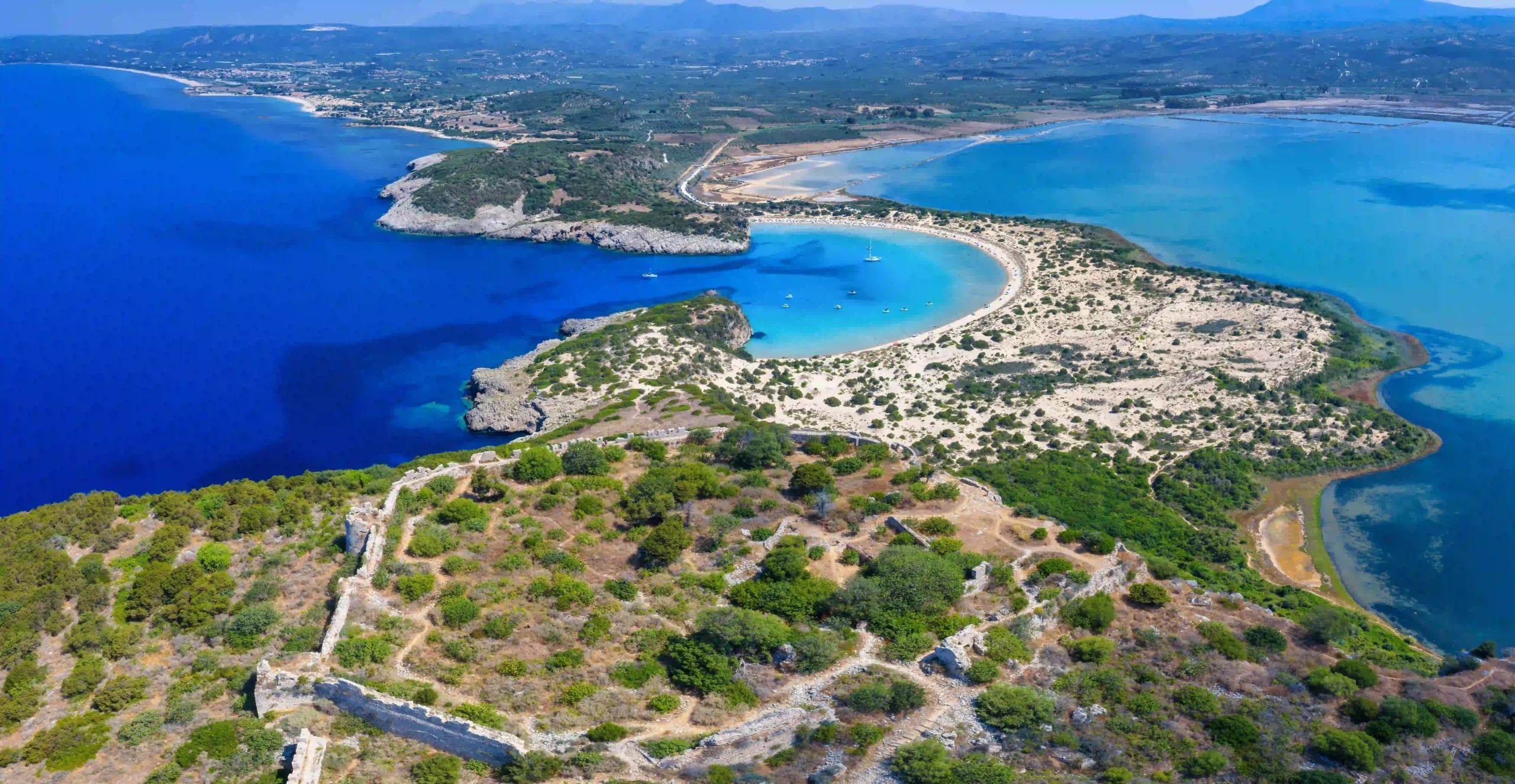
Voidokilia is a near-perfect horseshoe of white sand forming a natural “Ω” shape, backed by dunes and shallow turquoise water. There are no permanent buildings on the sand itself and minimal facilities, which keeps it feeling relatively unspoiled. That last part matters more than it sounds.
You’ve probably seen the aerial photos — the perfect arc of turquoise, the pale dunes, the castle ruins on the hill behind it. The good news: it really does look like that. The photos aren’t lying. The drone just doesn’t show the 40 other people standing in the same spot.
What to Know Before You Go
Go early. Arriving before 9am makes a real difference — the water is still, the light is different, and you’ll have the place largely to yourself. By late morning in peak season, it fills up fast.
Voidokilia Beach is a protected natural area with no organised facilities. Visitors should bring their own essentials, including water, snacks, sun protection, and umbrellas. This isn’t a beach with sunbed rentals and a bar behind it. Plan accordingly — especially in July and August when the heat is serious.
Hiking trails lead to Nestor’s Cave and the Old Navarino Castle above, offering both adventure and historical context. The trail up to Paleokastro from the beach takes about 25–30 minutes and delivers a 360-degree view over the lagoon, the bay, and the open Ionian Sea. It’s steep in places and there are no guardrails, so sensible footwear matters. The payoff is worth it.
Cost: Free. Parking nearby is also free.
Getting there: About 9km north of Pylos town, near Gialova. A car is the easiest option — there’s no reliable public transport to the beach directly.
2. Niokastro Fortress — The Castle That Actually Delivers
Standing guard over the entrance to Navarino Bay is Niokastro Castle, a 16th-century fortress built by the Ottomans and later used by the Venetians. The well-preserved castle houses the Pylos Archaeological Museum, featuring finds from Mycenaean tombs and Classical artefacts from the region.
The setting alone is worth the visit. From the fortress walls, the entire sweep of Navarino Bay opens up below you — Sfaktiria island, the harbour, the town, and on a clear day, the outline of Methoni in the distance.
What’s Inside (and What’s Honest)
The site itself is substantial. Four museums within the complex cover the area’s archaeological history plus an exhibit on maritime discoveries from the bay. Reviews from visitors are honestly mixed — some find it fascinating and well worth the time; others feel the ruins are more atmospheric than informative and that the entrance fee is steep for what you get.
One reviewer’s observation is worth flagging: the three small museums are modern and well-presented, with information in English. If history is your thing, plan for a full hour to ninety minutes. If you’re primarily a beach person, the exterior views from the harbour are free.
Cost: €10 (~$11 USD) per person.
Opening hours: Check locally before visiting — seasonal hours apply and the site sometimes closes for restoration work.
3. The Palace of Nestor — For History Lovers (With a Caveat)
About 17km north of Pylos near the village of Chora sits the best-preserved Mycenaean palace in Greece.
The Palace of Nestor is a testimony to ancient knowledge that has survived three thousand years. The fact that the palace is excellently preserved because it was destroyed by fire is a bit of a paradox. The fire baked the clay tablets in the palace’s archives, and these provide invaluable information about language, religion, and economic life in the palace itself and the surrounding area. Around 1,000 Linear B tablets were recovered during excavations — some of the most significant finds in Greek archaeology.
Manage Your Expectations
Tripadvisor reviews tell two very different stories. For visitors with a real interest in Mycenaean history, the site is deeply rewarding — particularly the throne room and the ancient bathtub referenced in Homer’s Odyssey, where Telemachus was bathed by Nestor’s daughter.
For visitors expecting something visually dramatic, it can feel sparse. There’s less standing than at some other sites, and the artefacts themselves have mostly been moved to the museum in Chora (a short drive away, included in the entrance ticket). If you’re visiting both the palace and Niokastro, the Chora museum is the more informative experience — plan it as part of the same day.
Cost: €10 (~$11 USD). The Chora archaeological museum is included in the same ticket.
Time needed: About 45 minutes for the site alone; add another 30–45 minutes for the museum.
4. Gialova Lagoon — Greece’s Quietest Wildlife Surprise
Most visitors who come to Pylos for the beaches drive straight past this.
Just north of Pylos, Gialova Lagoon is a shallow coastal wetland of international importance. Over 250 bird species have been recorded here, including flamingos during migration periods. Boardwalks and trails, plus a small observation area, make it accessible to non-specialist birdwatchers.
This is a Natura 2000 protected wetland — the same conservation category as some of Europe’s most significant nature reserves. The rare African chameleon has been recorded here. Flamingos pass through during migration. It’s the kind of place that rewards people who stop, slow down, and actually look.
You don’t need to be a dedicated birdwatcher to enjoy it. The walk along the lagoon edge toward Voidokilia is one of the better walks in the area — marshland on one side, the Ionian on the other — and pairs naturally with a morning visit to the beach. Early morning or late afternoon gives the best light and the most wildlife activity.
Cost: Free. Parking available at the Gialova end.
Best time: Spring (April–May) and autumn (September–October) for migratory species. Flamingos are most likely outside peak summer.
5. A Boat Trip on Navarino Bay — History Below the Surface
Navarino Bay looks like a calm, sheltered harbour. It is. But beneath the surface, the remains of the Ottoman and Egyptian fleet lie exactly where they sank on 20 October 1827 — the last major naval battle fought entirely with sailing ships, and the engagement that effectively secured Greek independence.
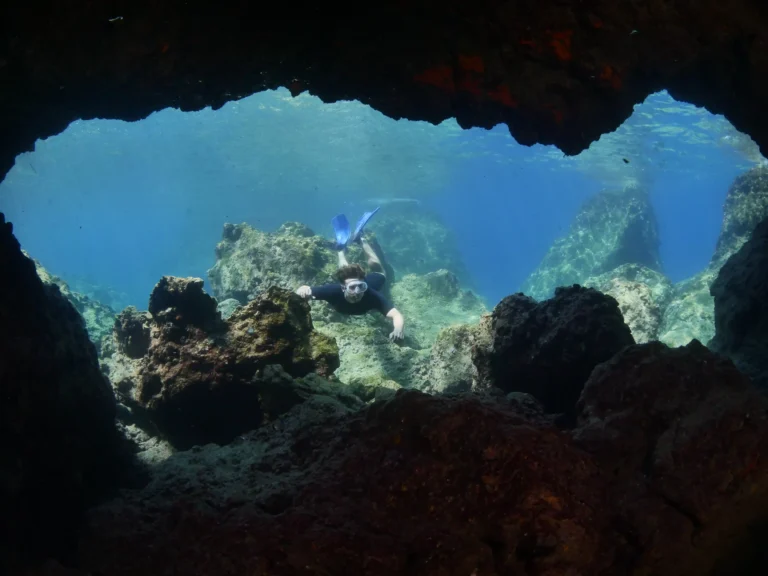
The calm, lake-like waters of the bay are ideal for an unhurried sea kayaking journey or an open water swim. Several operators in Pylos and Gialova offer boat tours — both shared cruises and private rentals — that take in Sfaktiria island, the French, English, Russian, and Italian memorials to the fallen, sea caves along the cliffs, and swimming stops in the bay’s clear water.
The Trigilidas travel operator runs a popular 2–3 hour cruise to Sfaktiria island from Pylos harbour, combining a guided hike on the island with swimming stops. Individual rates vary — check with local operators at the harbour for current pricing. A typical day cruise runs in the range of €20–€30 (~$22–$33 USD) per person for group tours.
Tip: Book directly at the harbour in Pylos, or ask your accommodation for a recommendation. Quality and price vary between operators.
6. The Pylos Town Square — The Best Free Thing You Can Do Here
Before or after any of the above, spend time in Pylos itself.
The timeline here is worth knowing. The Battle of Navarino happened in October 1827, when Allied fleets from France, Britain, and Russia destroyed the Ottoman and Egyptian armada in a single afternoon — the decisive engagement that tilted the balance toward Greek independence. The following year, French General Maison led an expeditionary force to push remaining Ottoman troops out of the Peloponnese entirely. With the Ottomans gone, French engineers were brought in to rebuild the town in 1829. So yes — two years between the naval battle and the redesigned town. The three admirals honoured by the central monument are the commanders of those 1827 fleets, and the square itself was built to mark what they made possible.
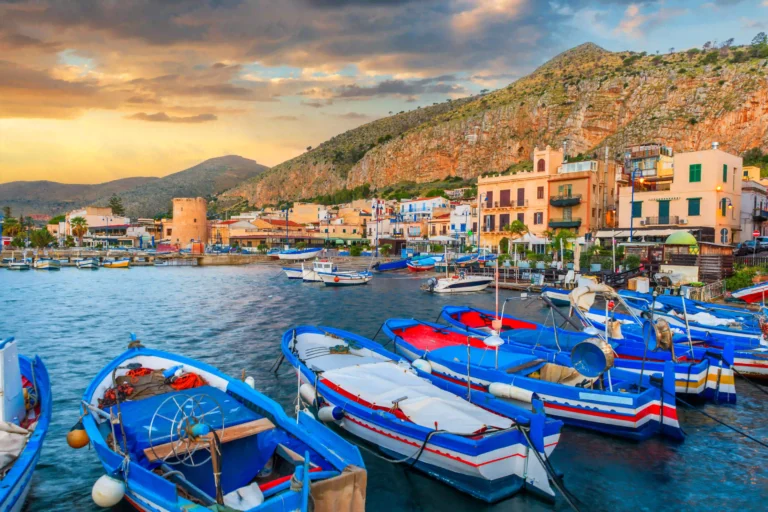
Ancient plane trees provide a massive canopy for long, unhurried coffees. In Pylos, the evening volta (stroll) along the promenade is a ritual. At the harbour-side tavernas, local Messinian flavours like hilopites (handmade pasta) and orange-scented sausages take centre stage.
This is one of those towns that reveals itself gradually. The first hour feels like a quick stop. The second hour, you’re ordering another coffee. The third, you’re wondering why you didn’t book two nights.
7. The Odyssey (2026) — Pylos on the Big Screen
This is new, and worth knowing before you visit.
Christopher Nolan chose Pylos and the surrounding Messinia region as one of the primary locations for his $250 million adaptation of Homer’s The Odyssey, set for release on 17 July 2026. Filming took place across the region in March 2025, with a 37-metre wooden trireme sailed from Norway to the port of Pylos for the production.
The specific sites used are exactly the ones covered in this guide. Nestor’s Cave above Voidokilia Beach was used to film the Cyclops Polyphemus sequence — which feels almost too fitting given the cave’s mythological connection to King Nestor. Almyrolakkas Beach in Gialova, Methoni Castle, and the town of Pylos itself also feature in the film. Matt Damon plays Odysseus, with a cast that includes Tom Holland, Zendaya, Anne Hathaway, Robert Pattinson, Charlize Theron, and Lupita Nyong’o.
The short version: you can stand in the exact cave where Nolan filmed the Cyclops sequence, on the same beach that appears in a $250 million IMAX production. For anyone with even a passing interest in film or mythology, that’s not nothing.
Whether or not the film adds to visitor numbers remains to be seen — but it’s a reasonable bet that Voidokilia and Nestor’s Cave will be busier in the second half of 2026 than they’ve ever been. Another reason to go early in the day.
How Do You Get to Pylos? (And Do You Need a Car?)
Short answer: yes, a car makes the whole trip significantly better.
The easiest way is to fly into Kalamata International Airport and drive about an hour to Pylos. There are also bus connections and scenic driving routes from Athens (around 3.5 hours).
Without a car, you can reach Pylos town by KTEL bus from Kalamata, and the town itself is walkable. But Voidokilia Beach, the Palace of Nestor, and Methoni Castle (a worthwhile half-day trip about 12km south) all require either a car, a taxi, or a tour.
If you’re building a longer Peloponnese itinerary, Pylos works well as a 2–3 night base. For help planning how to structure your time, our travel itineraries guide has practical frameworks for independent trips. For budget travel tips including how to rent cars cheaply across Europe, that’s worth a read before you book.
Car rental tip: Pick up at Kalamata airport. Prices vary significantly by season — book ahead in July and August.
When Is the Best Time to Visit Pylos?
The best time is spring (April–June) and autumn (September–October) for pleasant weather and fewer crowds.
June and September are the sweet spots: warm enough to swim, cool enough to enjoy walking and sightseeing, and meaningfully quieter than the peak July–August period. Spring is particularly good for Gialova Lagoon — wildflowers cover the hills around Voidokilia and migratory birds are active.
July and August are hot (temperatures regularly hit 35°C/95°F), busy, and require early starts at Voidokilia. If that’s when you’re going, plan beach time before 10am and save archaeological sites for late afternoon. With The Odyssey releasing in July 2026, expect heightened interest in the specific filming locations — Nestor’s Cave especially.
Winter visits are possible — the town is quiet and the landscape is beautiful — but expect most tourist-focused businesses to be closed.
A Few Practical Numbers
| Activity | Cost (EUR) | Cost (USD approx.) |
|---|---|---|
| Niokastro Fortress | €10/person | ~$11 |
| Palace of Nestor + Chora Museum | €10/person | ~$11 |
| Gialova Lagoon walk | Free | Free |
| Voidokilia Beach | Free | Free |
| Navarino Bay boat trip (group) | €20–30/person | ~$22–33 |
| Dinner at harbour taverna (2 people) | €40–60 | ~$44–66 |
| Mid-range hotel, per night | €70–140 | ~$77–154 |
For the full range of accommodation options — from budget guesthouses to harbour-view hotels — it’s worth comparing across booking platforms, as prices in Pylos move significantly between shoulder and peak season.
Pylos is the kind of place that ends up staying with you longer than expected. The history runs deep, the bay is striking in a way that photos don’t quite capture, and the town hasn’t been packaged for mass tourism in the way that parts of Santorini or Mykonos have. It rewards people who slow down.
Have you been to Pylos — or are you planning a trip? Drop your questions or tips in the comments. There’s always something that doesn’t make it into the guide.