Maine vs Nova Scotia: Which One Should You Visit?
Affiliate note: This article may contain affiliate links, which means I may earn a small commission if you book or buy through them – at no extra cost to you. I only recommend things that make sense for this kind of trip.
Maine vs Nova Scotia: Which One Should You Visit?
Rocky coastline. Lobster on every menu. Lighthouses that show up on every postcard rack within a mile. Small towns that empty out by 9pm. Cooler air than wherever you flew in from, and enough fog some mornings to make a lighthouse look like it’s guarding something more serious than a gift shop.
Maine and Nova Scotia share almost all of that. Which is exactly why people get stuck picking between them.
Here’s the actual difference. Maine is the easier trip — compact, familiar, and built for travellers coming from Boston or anywhere else in New England who don’t want logistics to be part of the vacation. Nova Scotia is bigger and more spread out, which makes it more work to plan and more rewarding if what you actually want is a trip that feels like it happened somewhere else, not just somewhere colder.
Neither one is the better destination. They’re built for different trips. This is a guide to figuring out which one is yours.
Quick Answer: Maine or Nova Scotia?
| Factor | Maine | Nova Scotia |
|---|---|---|
| Trip length | 4–6 days | 7–10 days |
| Starting point | Boston or New England | Anywhere — bigger-feeling road trip either way |
| Headline draws | Acadia, Portland, lighthouses, lobster rolls | Cape Breton, Halifax, the Bay of Fundy, the Cabot Trail |
| Logistics | Easier, more compact | More driving, more moving parts |
| The vibe | A classic New England coast trip | Something that feels more different from home |
If this is your first North Atlantic coastal trip and you want it simple, take Maine. If you want more room to move and a trip that doesn’t feel like a long weekend stretched thin, take Nova Scotia.
The Real Difference: Compact vs. Expansive
Maine’s coastal trip basically structures itself: Portland, the Midcoast, then Acadia. Three stops, one direction, done. You could plan the whole thing on a napkin.
Nova Scotia doesn’t offer that shortcut. It’s a full province with several distinct regions — Halifax, the South Shore, the Bay of Fundy, the Eastern Shore, and Cape Breton way out on the far end — and they don’t sit conveniently next to each other. Our Nova Scotia itinerary covers how those pieces fit together, but the short version is that fitting more than two of them into one trip takes real route discipline.
Maine is better if you want the trip to behave. Nova Scotia is better if you want it to stretch out a little.
Fewer hotel changes, fewer driving days, fewer decisions — that’s Maine’s whole pitch. Nova Scotia asks for more time and pays it back with more space between you and everyday life.
Best for First-Time Coastal Scenery
Maine’s version is concentrated: Acadia National Park packs rocky shoreline, granite peaks, and quiet coastal towns into a footprint you can circle in a few days. It’s the highlight reel, pre-edited.
Nova Scotia spreads its scenery out instead of stacking it. The Cape Breton itinerary and the Skyline Trail are the payoff, but they sit at the end of a long, real drive around the Cabot Trail, with the Cape Breton Highlands and the Bay of Fundy adding more scenery along the way that Maine simply doesn’t have room for.
Want the scenery in a smaller area you can actually finish? Maine. Want it to unfold gradually over days of driving instead of arriving all at once? Nova Scotia.
Best for Road Trips
Maine’s route is about as intuitive as coastal road trips get. Portland to the Midcoast to Acadia follows one road in one direction, with no border crossing if you’re already in New England.
Nova Scotia’s version — Halifax, the South Shore, the Bay of Fundy, then out to Cape Breton — works well on paper, but it takes real days to do properly. Cape Breton alone can fill several days, and close to a week if you want the slower version. The distances read smaller on a map than they feel behind the wheel.
Give Maine 4 to 6 days. Give Nova Scotia 7 to 10. And don’t try to do both in a week — you’ll spend more of it driving than anywhere else.
Best for Families
This isn’t just about drive time. It’s about what actually keeps kids interested once the scenery stops being enough.
Maine leans toward classic, structured fun: amusement parks outside Portland, tide pools and small coastal museums, lighthouse stops that do not require a full wilderness expedition, and enough ice cream stands to bribe your way through any meltdown. It’s the trip where the itinerary does most of the work for you.
Nova Scotia leans hands-on and a little wilder. Kids can dig for real fossils at the Joggins Fossil Cliffs, paddle a calm afternoon on Bras d’Or Lake, wander the reconstructed 18th-century streets at the Fortress of Louisbourg where costumed staff are in on the whole performance, and scan the water for real pilot whales on a whale watching tour in Pleasant Bay. None of that sits next door to the last thing, so check our where to stay in Cape Breton guide before picking a base.
Want the day planned for you: Maine. Want kids doing something with their hands instead of watching from a car window: Nova Scotia earns the extra driving.
Best for Budget
Skip the spreadsheet — neither destination is cheap in peak summer, because apparently everyone else also likes coastlines.
What actually moves the number: how far ahead you book, whether you need a rental car, the exchange rate if you’re coming from the US, park and tour fees, and how close to the obvious hotspots you’re staying. Bar Harbor rooms in July get expensive fast, and Cape Breton lodging tightens up the same way during peak season and again during Celtic Colours in the fall.
Maine can be the simpler budget option if you’re already in New England and skip flights entirely. Nova Scotia sometimes works out better value depending on the exchange rate, but longer distances and thinner lodging in smaller towns can eat that advantage back.
Compare trip length and logistics first. Then check actual lodging prices for your dates — that’s the number that matters, not a generic average.
Best for Solo Travellers and Couples
Maine keeps things tight and manageable solo: Portland’s food scene, a short drive to Acadia, coastal towns you can walk between meals.
Nova Scotia gives you more room to disappear into — longer, quieter stretches of road, especially once you get beyond the obvious stops, along the South Shore, the Bay of Fundy, and the far end of Cape Breton. If you enjoy driving and don’t mind your own company, that space is the whole appeal.
Best for Food
Maine has the edge for a short, food-focused trip. Portland’s restaurant scene is dense enough to eat well without much planning, and the lobster roll is basically the state’s calling card.
Nova Scotia’s food matches Maine dish for dish once you know what to order. Digby scallops off the Bay of Fundy, a late-night Halifax donair with its sweet, garlicky sauce, and a glass of Tidal Bay — the province’s own crisp, cool-climate white wine — hold up fine against a lobster roll. Add Acadian rappie pie along the French shore and Cape Breton evenings where a meal turns into a kitchen party without warning, and it’s not really a fair fight in Maine’s favour anymore.
If food is the whole trip, Maine’s easier to build around. If it’s one piece of a longer trip, Nova Scotia has more than enough to carry its side of the argument.
Best for Culture and Atmosphere
Maine’s atmosphere leans on its towns and maritime history — clapboard houses, working harbours, lighthouses photographed more times than anyone can count.
Nova Scotia carries more living culture into the trip. Halifax has real city energy, the province sits within Mi’kma’ki with a Mi’kmaw presence that predates everything else on this list, Acadian communities hold their traditions along the coast, and Cape Breton’s ceilidh culture means live fiddle music on an ordinary Tuesday. Time it right and you’ll catch Celtic Colours in October.
If a polished coastal town is what you want, Maine delivers it cleanly. If you want culture that feels lived-in rather than curated, Nova Scotia is the stronger pick.
Best for Avoiding Crowds
Be honest with yourself here: nowhere on this list is crowd-free in July and August.
Acadia and Bar Harbor get properly packed in peak season — the Cadillac Mountain vehicle reservation system the National Park Service now runs for summit access is a direct result of how much traffic the park pulls in. Basing yourself in a quieter Midcoast town instead of Bar Harbor itself takes some of the edge off.
Nova Scotia has its own pinch points — Peggy’s Cove, Halifax’s waterfront, and the busiest Cabot Trail overlooks all get crowded on a summer afternoon. But the province has more room to spread into if you’re willing to plan past the obvious stops.
Maine is easier to plan around, but its hotspots hit harder. Nova Scotia gives you more room to route around the crowds, provided you’ve got the days to do it.
Best by Trip Length
| Time Available | Better Choice | Why |
|---|---|---|
| 3–4 days | Maine | Easier from Boston/New England; compact route |
| 5–6 days | Maine, or a tightly focused Nova Scotia trip | Maine fits comfortably; Nova Scotia means picking one region |
| 7 days | Toss-up | Maine can feel complete; a focused Nova Scotia trip works too |
| 8–10 days | Nova Scotia | Enough time for Halifax, the South Shore or Fundy, and Cape Breton |
| 10+ days | Nova Scotia, or both if you plan carefully | More time turns the spread-out geography into an asset |
Combining both is tempting once you see them on a map next to each other. With less than 10 days, resist it.
What If You Want to Combine Maine and Nova Scotia?
You can, but that is a different planning problem from choosing between them.
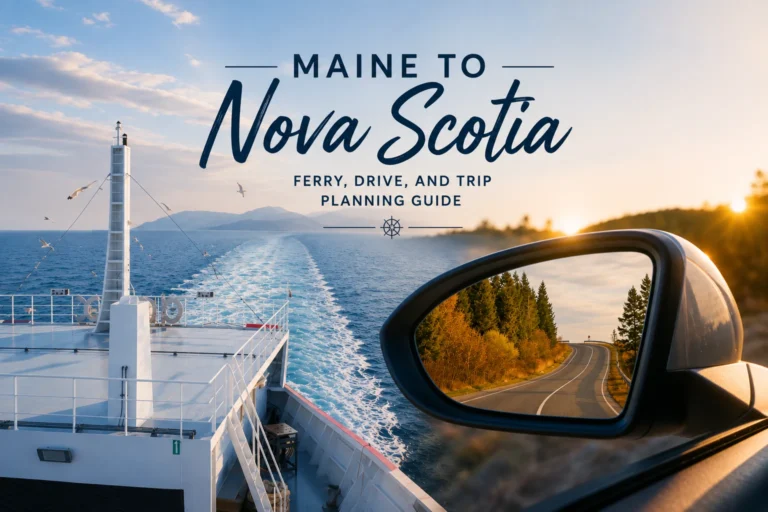
The main link between the two is The CAT ferry, a seasonal high-speed car ferry between Bar Harbor, Maine, and Yarmouth, Nova Scotia. For 2026, the ferry operator lists a 3.5-hour crossing and a season running from May 14 to October 14, but schedules, fares, and border requirements can change, so confirm everything directly before building a trip around it.
The bigger point: treat Maine plus Nova Scotia as one longer New England-and-Maritimes trip, not a quick hop between nearby stops. Portland, Acadia, Halifax, and Cape Breton are not next-door neighbours no matter how friendly the map looks.
If you have less than 10 days, choose one. If you have 10 to 14 days or more, combining them can work — but the ferry, the drive, border documents, and route order deserve their own guide.
Traveller Type Framework
Choose Maine if you are…
- A first-time North Atlantic coastal traveller
- Starting from Boston or elsewhere in New England
- Short on time
- Mostly there for the food
- Not thrilled about long rural drives
- Focused specifically on Acadia
- Travelling with younger kids and want easier logistics
Choose Nova Scotia if you are…
- Looking for a bigger-feeling road trip
- Set on Cape Breton and the Cabot Trail
- Comfortable behind the wheel for long stretches
- After music, culture, and community as much as scenery
- Working with 7–10 days
- Wanting a trip that feels less like a standard US coastal getaway
- Someone who values space over convenience
My Recommendation
Four or five days from Boston: Maine, no real debate.
Seven to ten days and you want the trip to feel bigger than the time you gave it: Nova Scotia.
Acadia is the dream: Maine. Cape Breton is the dream: Nova Scotia. It really is that specific for a lot of travellers once they say it out loud.
Young kids and a preference for the easier version: Maine. A slower family trip with enough runway to enjoy it: Nova Scotia works.
Trying to fit both into one week? Don’t. Pick one, do it right, and save the other for next time.
Frequently Asked Questions
Is Maine or Nova Scotia better for a first trip?
Maine, in most cases. The route is compact, the logistics are familiar if you’re coming from the US, and 4 to 6 days is enough to feel like you’ve actually seen it. Nova Scotia is just as worthwhile, but it rewards a longer trip and more planning — a better second coastal trip than a first one for many travellers.
Is Maine or Nova Scotia cheaper?
Neither is reliably cheaper — both get expensive in peak summer. Maine can work out simpler if you’re driving from New England and skipping flights. Nova Scotia’s value depends heavily on the exchange rate and how far off the main routes you’re willing to stay. Compare actual lodging prices for your travel dates rather than relying on a general rule.
Is Nova Scotia like Maine?
On the surface, yes — rocky coast, lighthouses, seafood, small towns. The difference shows up once you start driving. Nova Scotia is a full province with several distinct regions spread across real distances, while Maine’s coastal highlights sit much closer together.
Is Acadia or Cape Breton better?
Different experiences more than a head-to-head comparison. Acadia is a compact national park you can properly see in a couple of days. Cape Breton is a full island loop — the Cabot Trail, the Skyline Trail, whale watching, the Fortress of Louisbourg — that takes closer to a week to do without rushing.
Can you visit Maine and Nova Scotia in one trip?
Yes, but it works better as a longer trip than a quick add-on. The CAT ferry between Bar Harbor and Yarmouth can help when it is operating, but schedules, fares, and border requirements need to be checked directly. Think 10-plus days, not a week.
Which is better for families?
Maine for shorter trips and younger kids, thanks to easier logistics and less driving. Nova Scotia works well for families with 7 or more days who can handle a slower-paced road trip.
Which is better without too much driving?
Maine. The Portland-to-Acadia route is short enough that driving never becomes the main event. Nova Scotia’s regions sit farther apart, so long driving days are part of the deal if you want to see more than one part of the province.
Which is better in summer?
Both hit their stride in July and August, and both get crowded because of it. Maine’s hotspots like Bar Harbor feel the crowding more intensely; Nova Scotia has more room to route around it if you have the days to spend.
Which is better in fall?
Nova Scotia has a strong case here, especially if your dates line up with Celtic Colours in Cape Breton — live music alongside the fall colours is hard to beat. Maine’s fall foliage around Acadia is excellent too, just on a smaller stage.
Which is better for quiet coastal towns?
Nova Scotia edges it out simply by having more of them spread across more coastline — the South Shore and the Eastern Shore both have towns that see a fraction of Peggy’s Cove’s traffic. Maine has quiet corners too, mostly in the Midcoast away from Bar Harbor, but they’re harder to find in peak season.
The Short Version
Maine is easier, more compact, and more familiar — the safer call for a 4 to 6 day trip, especially from Boston or New England.
Nova Scotia is bigger, more spread out, and more distinctive — the better call if you’ve got 7 to 10 days and want the trip to feel like an actual departure from your regular life.
Neither is the wrong choice. The only real mistake is trying to force both into too little time.
Which way are you leaning — and what does your ideal version of this trip actually look like? Drop it in the comments.