Birdwatching at Gialova Lagoon: Greece’s Best-Kept Wetland Secret
Affiliate note: This article may contain affiliate links, which means I may earn a small commission if you book or buy through them – at no extra cost to you. I only recommend things that make sense for this kind of trip.
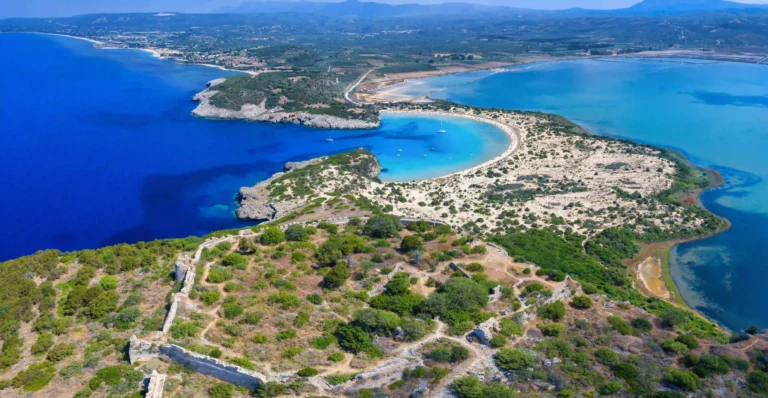
Most people visiting Pylos spend their time at Voidokilia Beach. And they should — it’s extraordinary. But 800 metres up the road, separated from that famous horseshoe of sand by a narrow strip of dunes, is a 700-hectare wetland that most visitors walk straight past.
That wetland is Gialova Lagoon. And for anyone willing to show up with binoculars and low expectations about infrastructure, it might be the most memorable thing you do in the Peloponnese.
This guide covers what lives here, when to come, how to get around, and whether you need to be a serious birder to enjoy it. (You don’t.)
What Makes Gialova Lagoon Special?
Here’s the short version: Gialova Lagoon is Greece’s southernmost major wetland. It sits at the northern tip of Navarino Bay, where fresh water from the river Tifaiomitis mixes with the sea to create a mosaic of brackish lagoons, freshwater marshes, mudflats, and reedbeds. That variety of habitats — all compressed into a relatively small area — is exactly why so many bird species show up here.
The numbers: over 270 bird species have been recorded at the lagoon, including 79 protected species. For context, that’s roughly 60% of all bird species recorded in Greece, in a space you can walk around in a morning.
The lagoon was declared a protected area in 1997 and is now part of the Natura 2000 network, a pan-European system of ecological conservation zones. Attempts were made to drain the wetland in the 1950s — the standard approach to wetlands at the time — but the underground water table was too rich. The plans failed, and today the lagoon is better protected for it.
One more thing that distinguishes Gialova: its size is actually an advantage. The large wetlands of northern Greece are ecologically richer in absolute terms, but harder to work as a casual visitor. Here, a couple of hours at the observation tower gives you a clear view of most of what the lagoon holds. You don’t need to know what you’re looking for. It finds you.
What Birds Can You See at Gialova Lagoon?
The answer depends almost entirely on when you visit — but there’s always something worth seeing.
The Year-Round Residents
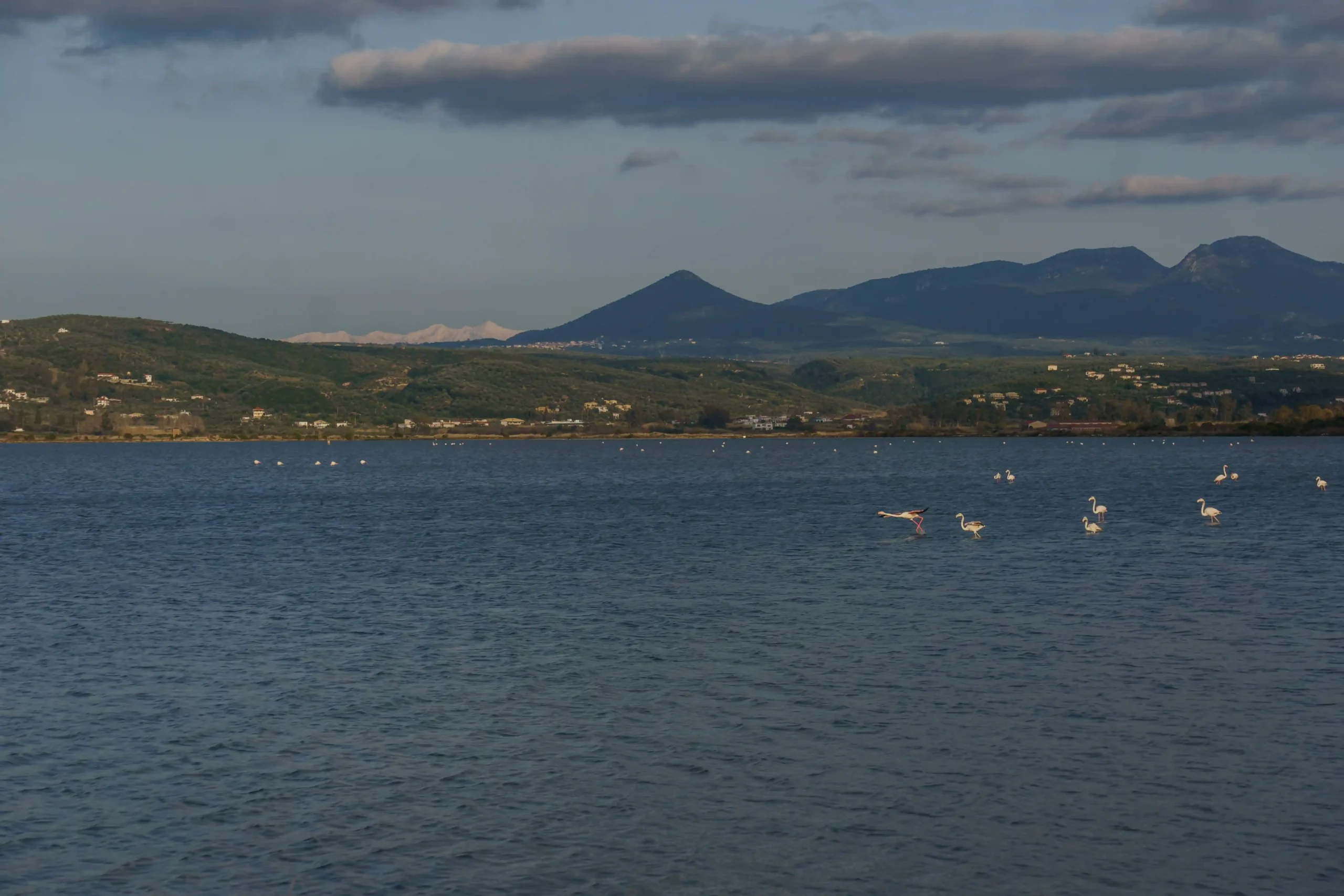
Flamingos are the headline act, and they’re present most of the year. Their pink colouring comes from the plankton in their diet, and they’re visible from the path without binoculars. Grey herons, little egrets, great egrets, cormorants, and coots are permanent fixtures. In winter, the lagoon hosts around 20,000 birds — ducks and coots are the most numerous, but the eagle sightings are what serious birders come for.
Autumn Migration (September–November)
This is when the lagoon really earns its reputation. Thousands of birds moving from Europe to Africa stop here to rest and feed before the 3,000km crossing over the Mediterranean and the Sahara. Ruffs, garganeys, grey herons, squacco herons, glossy ibises, golden plovers, black-winged stilts, and kingfishers are all reliably present from August onward.
September brings the osprey — arguably the most dramatic bird the lagoon hosts. Purple herons, marsh harriers, pallid harriers, most species of terns, common sandpipers, marsh sandpipers, spotted redshanks, and avocets also arrive in September.
October brings large flamingo populations. If there’s a single month that balances warm weather with the widest range of species, it’s October.
Spring Migration (March–May)
The return journey north brings an equally diverse cast. April and May are considered the best months for spring migration, with White-winged Terns, Kentish Plovers, and Collared Flycatchers adding variety to the resident species. Waders and herons dominate, and the reedbeds fill with breeding activity.
Winter (December–February)
Quieter, but not empty. Bitterns are present — about ten individuals, typically — and can be spotted flying above the reedbed around dusk. Imperial eagles, spotted eagles, and marsh harriers join the year-round residents. It’s cold enough that you’ll want layers, but the lack of crowds makes for good watching.
How Do You Get Around the Lagoon?
There are a few options, and the right one depends on how much time you have.
The Walking Path
A flat, well-marked circular trail starts at the Hellenic Ornithological Society’s information centre at the old pumping station. It loops around the perimeter of the lagoon, passing through the different habitats — salt lagoon, freshwater marsh, reedbed — and is the best way to understand what makes the ecosystem work. It’s signposted throughout, and the rules are posted at the entrance: stay on the path, keep noise down, don’t disturb the vegetation near the water.
There are two enclosed birdwatching hides — one on the path to the lagoon and one at Voidokilia — plus a high open-air observation tower with clear views across the main lagoon. Binoculars help considerably at the tower. For the flamingos along the path, you can see them fine without.
Allow 2 to 3 hours to do the full loop properly.
By Bike
A flat road runs from Gialova village along the edge of Divari Beach and north toward Voidokilia, passing through the heart of the lagoon area. This is an excellent morning ride — the full route to Voidokilia and back is around 10–12 km, largely flat, and passes through landscapes that feel a world away from anything touristy.
Martin’s Rentals in Gialova offers bicycle and e-bike hire. An e-bike is worth considering if you want to cover more ground or save energy for the walk around the lagoon itself.
Guided Tour
Navarino Outdoors offers guided lagoon experiences on foot and by bike, including birdwatching-focused tours with local guides who know the species and the seasonal patterns. An e-bike tour of the Navarino Trail — which includes the lagoon area, local snacks, and professional guiding — runs around €90 / $98 per person for approximately 4 hours. Group size is capped at 20, which keeps it manageable.
If you’re not a birder but want the context, a guided tour adds a lot. The difference between “that’s a heron” and understanding why herons are here, what they’re doing, and where they fit in the seasonal cycle is the difference between watching and seeing.
When Is the Best Time to Visit Gialova Lagoon?
The honest answer: September to May covers the best of it. That’s a broad window, and each part of it offers something different.
October is the peak of autumn migration — maximum species variety, large flamingo numbers, ospreys reliably present, and the weather is still warm enough to be comfortable.
March–May is the best window if you’re visiting during a wider Greece or Peloponnese trip. Spring migration is active, breeding activity is visible in the reedbeds, and the Peloponnese in spring is beautiful in a way that peak summer doesn’t quite replicate.
June–August works if you’re already in the area — the resident species are here, the flamingos are here, and combining a morning at the lagoon with a swim at Voidokilia is a perfectly reasonable day. Just don’t expect the migration variety.
Timing within the day matters more than most people realise. Come early morning — before 9am if possible. The light is better for spotting movement, the wind hasn’t picked up yet, and the birds are most active. The same principle applies here as it does at most wildlife sites: the people who arrive at 10am and leave by 11am see a fraction of what’s available.
What Does It Cost?
Entrance to the lagoon: free. There’s no ticket booth, no visitor centre charge, no organised admission. Approach from Gialova village via the beach road, or park at the barrier 3km north of the village and walk counter-clockwise around the northern lagoon to reach the observation tower.
If you rent a bike: expect to pay around €15–25 / $16–27 per day for a standard bicycle, and €30–50 / $33–55 for an e-bike, depending on the provider and season.
Guided e-bike tour (Navarino Outdoors or Explore Messinia): approximately €90 / $98 per person, including guiding, snacks, and equipment. These tours typically last 4 hours and include the lagoon and surrounding area.
No specialised birdwatching kit is required, though binoculars make a real difference at the observation tower. The three birdwatching hides are free to use — just be quiet going in and out.
Is Gialova Lagoon Worth It If You’re Not a Birdwatcher?
This is probably the most useful question to ask.
The honest answer: yes, with some caveats.
The lagoon isn’t a safari park. Nothing is guaranteed, nothing is staged, and there are stretches of path where you’ll see more reeds than birds. If you come expecting the wildlife equivalent of a fairground, you’ll be underwhelmed.
But if you come with a bit of patience and curiosity — and especially if you come early — what you actually experience is something quieter and stranger. Standing at the observation tower at 8am, watching a group of flamingos drift through flat pink water while an egret holds completely still twenty metres away, is the kind of thing that slows a trip down in a good way.
There’s also the fact that Gialova Lagoon is one of only two places in Europe where you can see the African chameleon in the wild. The chameleons are not the main reason to visit, but they’re remarkable when you spot one, and the fact that they exist here — in a small village in the Peloponnese — is the sort of detail that makes you wonder what else you’ve been walking past without noticing.
The lagoon is also a 5-minute drive from Voidokilia Beach. Combining a morning at the lagoon with an afternoon swim is the obvious itinerary, and it’s a good one. If you’re planning a broader trip around the region, our guide to the best things to do in Pylos covers everything from Nestor’s Palace to the Niokastro fortress and boat trips on Navarino Bay.
Practical Visitor Notes
Getting there: Gialova Lagoon is about 8 km north of Pylos by road. From Gialova village, take the beach road heading north. The Ornithological Society’s information centre is near the old pumping station. Parking is available at a barrier 3km along the beach road — walk from there.
What to bring: Binoculars (10×42 is a good general birdwatching spec if you have them). Water and snacks — there are no facilities once you’re on the trail. Sun protection. Comfortable walking shoes — the path is flat and well-maintained but unpaved.
Photography: The observation tower gives the best elevated angle over the freshwater lagoon. Early morning light is most favourable and the wind is calmer, reducing shimmer on the water surface.
Noise: Keep it down, especially near the hides and the reedbeds. This isn’t a rule just for serious birders — it’s the reason why the birds are close enough to see in the first place.
Mobile signal: Adequate in Gialova village, patchy on the trail. Download an offline map or the AllTrails route before you go.
The Bigger Picture
Gialova Lagoon was nearly destroyed sixty years ago. The drainage plans failed, but the wetland still lost a third of its area to canals and roads before conservation efforts took hold. Today it’s better managed than it’s been in decades — the Hellenic Ornithological Society runs monitoring and education programs from the information centre, and the Natura 2000 protection provides legal cover.
None of that is especially dramatic to read about. But standing at the tower watching an osprey circle above the main lagoon — knowing that this same bird stopped here on its way from Africa, that the lagoon fed it before the Sahara crossing, that the wetland only exists because a drainage project failed — there’s something in that chain of coincidences worth taking a minute with.
The beach down the road is beautiful. Come here first.
Planning a trip to Pylos? Our full guide to the best things to do in the area covers Voidokilia, the Palace of Nestor, Niokastro fortress, and boat trips on Navarino Bay — everything you need to build a proper itinerary. Have questions about visiting Gialova Lagoon, or tips from your own visit? Drop them in the comments.